Toolbox Chaos procedure
Fixed-Step Integration Method Comparison
Run Euler, Heun, and RK4 on a compatible continuous ODE flow under the same inputs, interpret finite-horizon separation, and design a defensible step-refinement check.
Question and result
Calculation performed
Evaluate numerical sensitivity for a compatible ODE flow by distinguishing solver disagreement from a dynamical effect.
Required configuration
- Use a compatible continuous ODE flow, preferably a supported three-state catalog case such as Lorenz, Rossler, or Chua, with a fixed parameter vector, initial condition, step, and duration.
- Use this tutorial with compatible continuous ODE flows. Discrete maps, Mackey–Glass delay dynamics, and Lorenz-96 follow their own update contracts and analysis workflows.
- Understand that sensitive trajectories can diverge pointwise even when two reliable methods reproduce the same statistical regime.
Panel and figure
Displayed quantities
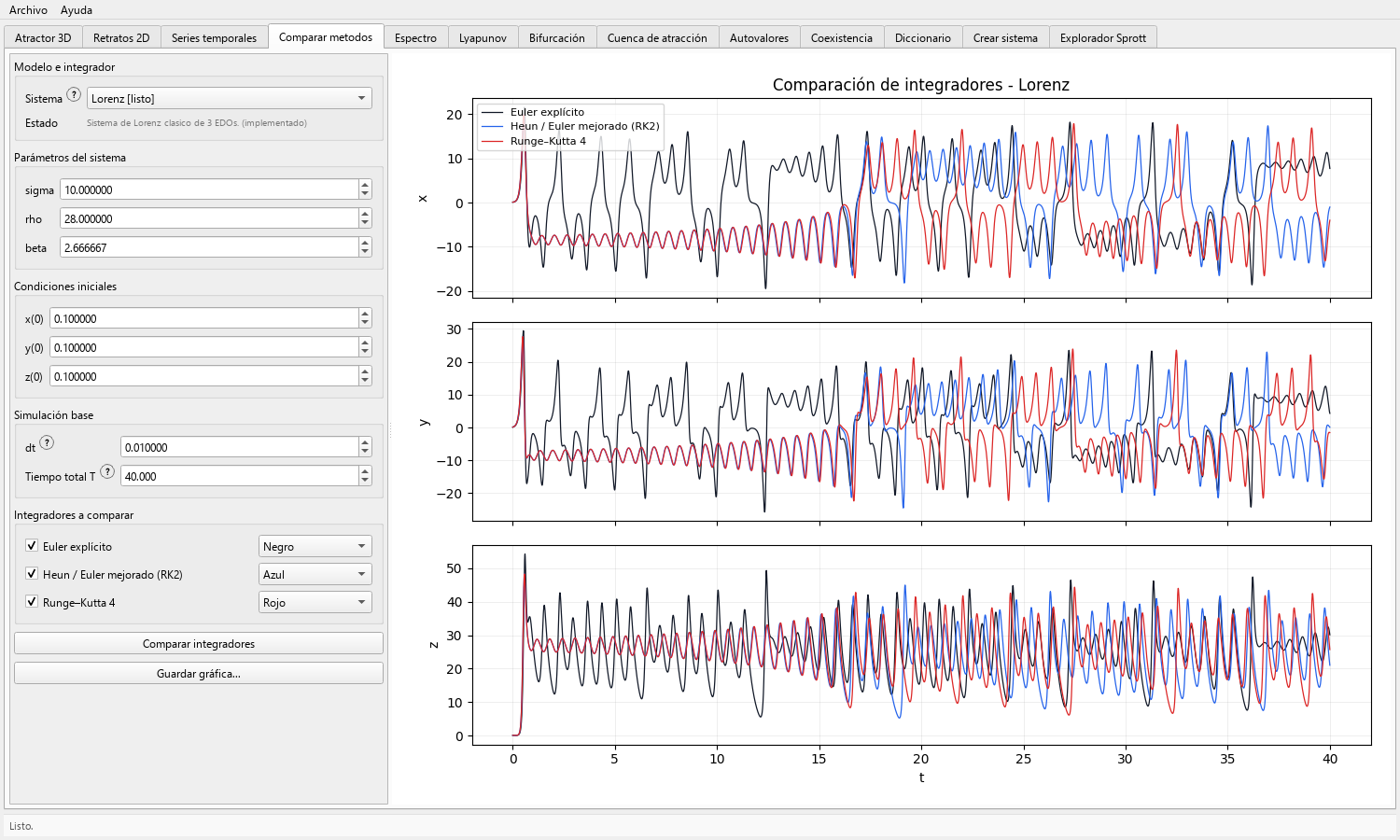
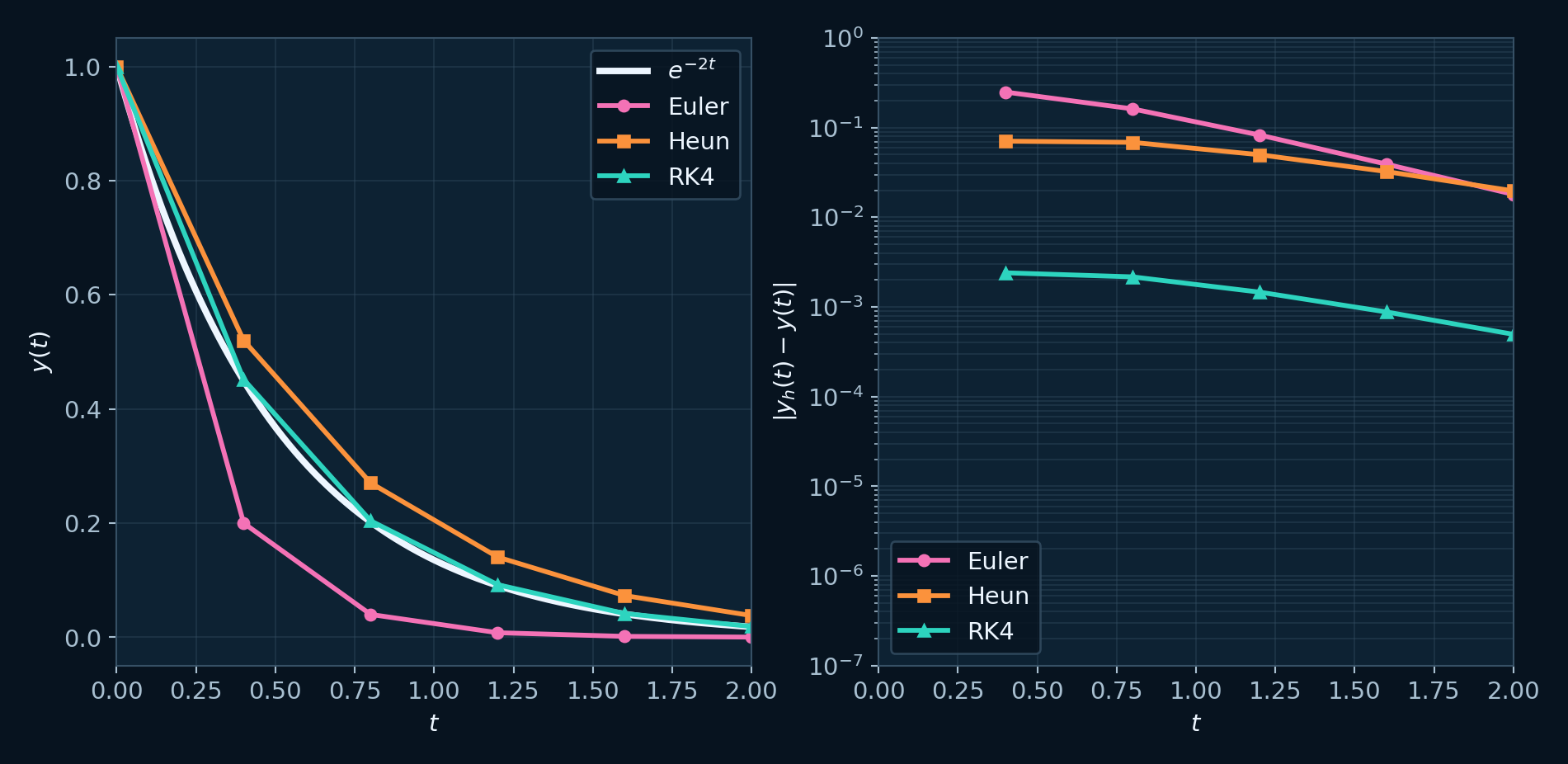
Configuration and calculation
Control sequence
-
Define a common experiment
Select one compatible continuous ODE flow, its parameters, one initial state, step dt, and duration T. These values are shared by all checked methods.
Begin with a moderate duration so early error growth can be read before long-time sensitive divergence dominates.
-
Select the methods
Enable Euler explícito, Heun / Euler mejorado (RK2), and Runge–Kutta 4. Assign distinct high-contrast colors.
This interface compares the three fixed-step methods Euler, Heun, and RK4. Adaptive error-controlled integration requires its own analysis workflow.
-
Generate the overlay
Press Comparar integradores and inspect early agreement, phase drift, amplitude changes, boundedness, and any method-specific failure.
Base accuracy assessment on step refinement, boundedness, and agreement across the declared diagnostics.
-
Repeat at half the step
Keep model, initial state, and horizon fixed; halve dt and regenerate the overlay.
Look for improved early agreement and convergence of bounded regions, dominant frequencies, extrema distributions, or other quantities relevant to the study.
-
Separate transient and asymptotic questions
Use a short window to assess local integration agreement and a longer window to compare robust summaries.
When a conclusion changes after halving the step, record the result as numerically unresolved and refine the experiment.
-
Export a comparison record
Save the comparison figure for each tested step and name the files with the step and horizon.
Report the list of enabled methods, the step, and the horizon so the comparison record identifies every computed trace.
A practical comparison matrix
- Rows: Euler, Heun, and RK4.
- Columns: dt, dt/2, and—when needed—dt/4.
- Fixed inputs: equations, parameter vector, initial condition, and observation horizon.
- Declared outputs: early-time deviation, boundedness, phase portrait, dominant spectral peaks, or another problem-specific summary.
- Decision: adequate, inadequate, or unresolved at the tested resolution.
Record
Computed data
- An overlay showing where Euler, Heun, and RK4 agree or separate for identical inputs on a compatible ODE flow.
- A two-level step study that indicates whether the qualitative conclusion is stable enough for exploratory use.
Scientific reading
Interpretation criteria
Early-time agreement that improves with step refinement supports numerical consistency. In a sensitive system, assess late-time separation together with boundedness, phase structure, and step refinement.
A solver that diverges, changes the apparent regime, or retains large discrepancies after refinement signals that the chosen step or method is inadequate for the stated purpose.
Files
Experiment record
- Record every enabled method, dt, T, parameters, and initial state.
- Export both original-step and refined-step figures.
- State the comparison criterion: early trajectory, geometry, extrema, spectrum, or another declared quantity.
Applications
Questions addressed by the calculation
- Teaching truncation error and numerical sensitivity.
- Selecting a practical method and step before a larger parameter campaign.
- Documenting that a qualitative portrait or diagnostic persists under coarse-to-fine step refinement.
Scope
Evidence conditions
- The panel compares the implemented fixed-step methods under one declared ODE-flow contract.
- Compatible continuous ODE flows use the Euler, Heun, and RK4 comparison; maps, delay equations, and Lorenz-96 follow their own update contracts.
- For chaotic trajectories, compare large-scale geometry, statistics, and declared diagnostics across refinements.
- Method agreement supports numerical consistency and is reported with the diagnostics used for dynamical interpretation.