Atractores coexistentes
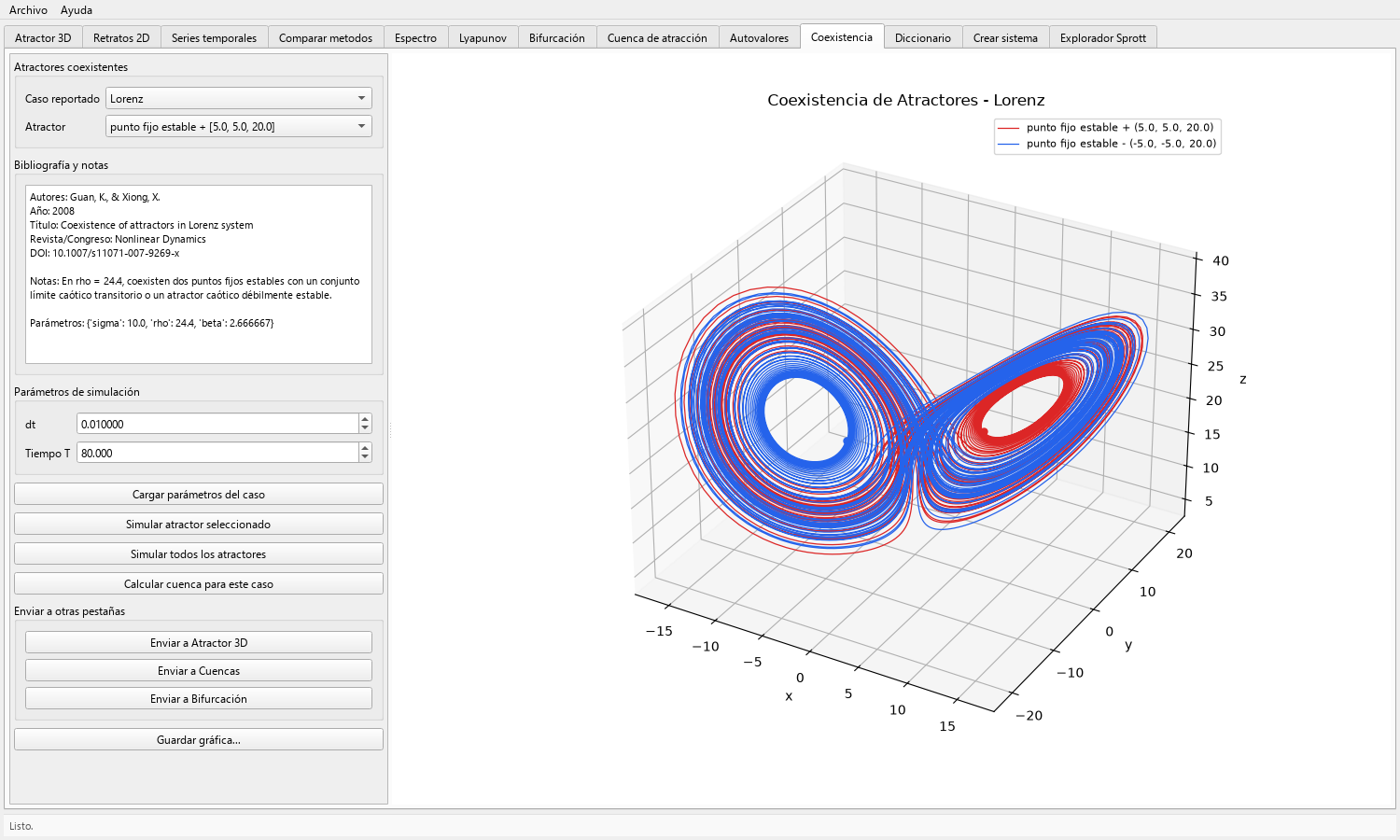
Compare el caso de coexistencia de Lorenz registrado: los mismos parámetros, dos condiciones iniciales y dos destinos estables coexistentes.
Pregunta y resultado
Cálculo que realizará
Comparar trayectorias registradas bajo un conjunto fijo de parámetros y utilizar sus distintas condiciones iniciales para estudiar destinos calculados diferentes.
Pestaña de la interfaz
Pestaña de la interfaz
Coexistencia
Configuración y cálculo
Secuencia de controles
- Seleccione un caso de coexistencia registrado y revise su referencia y conjunto de parámetros. Las simulaciones de coexistencia leen directamente el parameter_set registrado como parte de su configuración.
- Elija un atractor registrado o simúlelos todos con el mismo dt y tiempo total.
- Confirme que las ecuaciones y los parámetros permanezcan fijos mientras las condiciones iniciales aportan la variación del experimento.
- Use Calcular cuenca para este caso para continuar directamente: la aplicación cambia a Cuenca de atracción, carga el caso y ejecuta de inmediato la configuración actual de ventana, malla, paso y tiempo total de la cuenca.
- Use Enviar a Atractor 3D, Enviar a Cuencas o Enviar a Bifurcación para copiar el sistema seleccionado, los valores de los parámetros y la condición inicial elegida al espacio correspondiente.
- Revise los controles propios de la pestaña de destino antes de calcular; enviar un caso cambia el espacio de trabajo y requiere completar su configuración numérica específica.
Registro
Datos obtenidos
- Una o más trayectorias que muestran los destinos alcanzados desde inicios registrados bajo los mismos parámetros del modelo.
- Un espacio de destino precargado con el caso de coexistencia seleccionado para inspección 3D, muestreo de cuencas o barrido de parámetros.
- Al usar el botón directo de cuenca, una cuenca recién calculada para el caso cargado con los controles actuales de muestreo de la pestaña Cuenca.
Lectura científica
Criterios de interpretación
Los destinos calculados distintos bajo ecuaciones y parámetros idénticos constituyen evidencia numérica finita de coexistencia para las condiciones iniciales y la configuración probadas.
Los botones de transferencia permiten un flujo de análisis coherente. Interprete el mapa de cuencas o el diagrama de bifurcación con su propio contrato numérico junto con la comparación de trayectorias.
El resultado directo de la cuenca debe interpretarse según su plano, malla y tiempo finito de integración declarados, aunque se haya iniciado desde el caso de coexistencia.
Archivos
Registro del experimento
- Use Guardar gráfica... para guardar la vista de coexistencia después de comprobar que se distinguen todas las trayectorias y etiquetas de condiciones iniciales.
- Registre el caso, el sistema, los parámetros ordenados, cada condición inicial probada, el método, dt, el tiempo total y cualquier ajuste de la pestaña de destino utilizado después de una transferencia.
Aplicaciones
Preguntas que admite el cálculo
- Enseñar multiestabilidad y el papel de las condiciones iniciales bajo un conjunto fijo de parámetros.
- Seleccionar casos para vistas 3D, muestreo de cuencas o análisis de bifurcación con los datos compartidos del modelo transferidos directamente.
- Diseñar comparaciones controladas de destinos candidatos y de su robustez numérica.
Alcance
Condiciones de la evidencia
- Comparar unos cuantos inicios registrados documenta la muestra declarada. La cartografía de cuencas amplía esa muestra mediante una malla y un horizonte especificados.
- La coexistencia documenta destinos distintos para los inicios probados. Identifique la clase de cada destino y verifique el asentamiento con un análisis de transitorio suficiente.
- El flujo de transferencia conserva la configuración entre vistas; la localización y certificación de atractores ocultos se realiza en Hidden Attractors FO.
Parámetros y destinos coexistentes
La coexistencia mantiene fijas las ecuaciones y los parámetros, mientras la condición inicial determina el comportamiento de largo plazo. El caso de Lorenz de Toolbox Chaos emplea el régimen sigma=10, rho=24.4 y beta=8/3; los inicios registrados se aproximan a dos equilibrios estables diferentes.
Ésta es una idea central de la multiestabilidad. El sistema se describe mediante sus ecuaciones y la región del espacio de fases donde comienza el experimento. Para caracterizarlo, compare una colección declarada de condiciones iniciales.
Simulación de condiciones iniciales registradas
- Abra el flujo de coexistencia en Toolbox Chaos.
- Seleccione el caso de coexistencia registrado de Lorenz.
- Revise los valores registrados
sigma = 10,rho = 24.4ybeta = 8/3. Las acciones de simulación leen automáticamente este conjunto de parámetros. - Compare las condiciones iniciales registradas
(5,5,20)y(-5,-5,20). - Simule ambas trayectorias en la misma figura.
- Interprete los destinos finales: una trayectoria se aproxima al punto fijo estable positivo y la otra al punto fijo estable negativo.
- Para un estudio inmediato sobre una malla, revise primero la ventana, la coordenada fija, la resolución,
dty el tiempo total en Cuenca de atracción. Regrese a Coexistencia y pulse Calcular cuenca para este caso; la aplicación carga el caso en esa pestaña e inicia directamente el cálculo de la cuenca. - Seleccione un atractor registrado y use Enviar a Atractor 3D, Enviar a Cuencas o Enviar a Bifurcación para copiar su sistema, parámetros y condición inicial. Revise los controles de la pestaña receptora y ejecute allí el análisis solicitado.
Parámetros y condiciones iniciales
- Condición inicial: es el control principal en la coexistencia. Cambiar sólo el inicio puede modificar el destino.
- rho: rho=24.4 muestra dos equilibrios estables de Lorenz; rho=28 muestra el atractor caótico clásico de Lorenz y corresponde a un estudio distinto.
- Tiempo total: si es demasiado corto, puede mostrar sólo transitorios. El destino se interpreta después de que la trayectoria se haya asentado.
- Tamaño de paso: un paso demasiado grande puede llevar numéricamente una trayectoria al destino equivocado.
- Ángulo de vista: la rotación modifica la claridad con que se separan los destinos simétricos en la figura 3D.
Coexistencia, cuencas y muestreo inicial
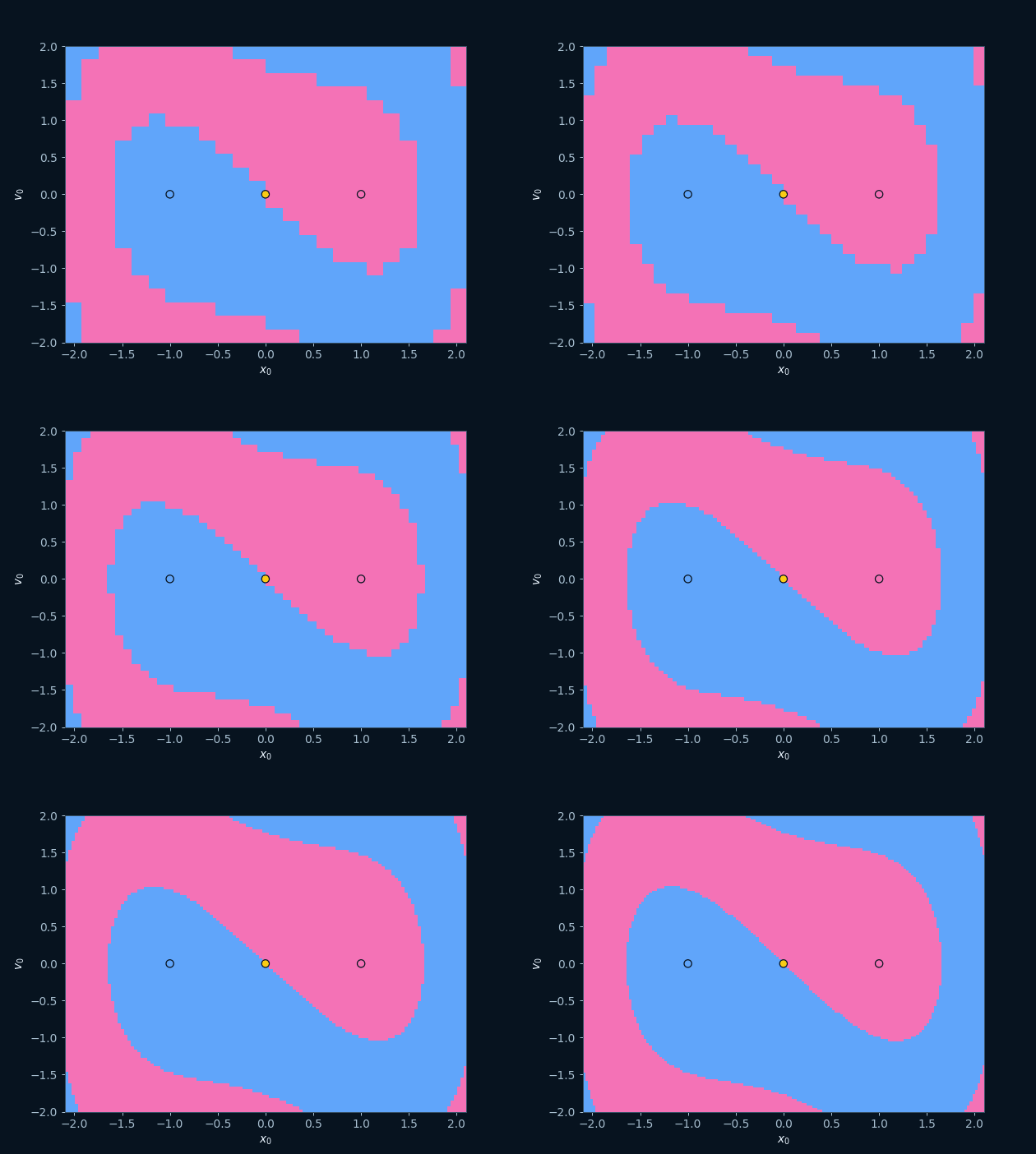
- Coexistencia y cuencas cumplen funciones distintas: una gráfica de coexistencia compara trayectorias seleccionadas; un mapa de cuencas clasifica muchas condiciones iniciales sobre una malla.
- Identifique la clase de atractor: el ejemplo de Lorenz muestra dos puntos fijos estables para el mismo conjunto de parámetros.
- Conserve los parámetros entre ejecuciones: esta condición mantiene el experimento de coexistencia y permite atribuir los destinos a las condiciones iniciales.