PSD de Welch y espectro de amplitud
Estime densidades espectrales de potencia de Welch o espectros de amplitud para todas las componentes de estado mostradas, conservando el eje físico de frecuencias.
Pregunta y resultado
Cálculo que realizará
Estimar y comparar el contenido en frecuencia de todas las componentes de estado mostradas mediante densidades espectrales de potencia de Welch o espectros de amplitud.
Pestaña de la interfaz
Pestaña de la interfaz
Espectro
Configuración y cálculo
Secuencia de controles
- Genere una trayectoria compatible o configure el sistema directamente en Espectro. La pestaña analiza y grafica todas las componentes de estado mostradas como conjunto de observación declarado.
- Defina el transitorio, el paso de integración, la duración total y los límites de frecuencia antes de elegir el resultado espectral.
- Use Welch PSD para una estimación promediada de potencia por frecuencia o Amplitude spectrum para la magnitud de componentes de Fourier. Conserve la etiqueta y las unidades correspondientes en cada resultado.
- Genere la gráfica y repita con una ventana retenida más larga o un dt menor para comprobar si persisten los rasgos principales.
Registro
Datos obtenidos
- Un eje de frecuencia coherente con el paso de muestreo de la trayectoria y una curva de Welch PSD o de amplitud por cada componente de estado mostrada.
- Picos dominantes, armónicos o regiones de banda ancha legibles dentro de los límites de frecuencia solicitados.
Lectura científica
Criterios de interpretación
Los picos estrechos pueden respaldar una interpretación periódica, mientras que un contenido más amplio puede acompañar un movimiento irregular; compare las curvas de las componentes porque cada coordenada puede destacar frecuencias distintas.
El contenido espectral es evidencia numérica complementaria y debe interpretarse junto con las trayectorias, las comprobaciones de transitorios y otros diagnósticos.
Archivos
Registro del experimento
- Guarde la gráfica después de confirmar el modo, las unidades, las etiquetas de las componentes y los límites de frecuencia mostrados en la figura.
- Registre el sistema, los parámetros, el estado inicial, el método de integración, dt, el tiempo total, el transitorio descartado, si se reutilizó la trayectoria, el modo espectral, las componentes mostradas y la ventana de frecuencia.
Aplicaciones
Preguntas que admite el cálculo
- Comparar frecuencias dominantes entre parámetros, componentes de estado o configuraciones numéricas.
- Caracterizar señales periódicas, aparentemente cuasiperiódicas e irregulares antes de un análisis más profundo.
- Preparar figuras espectrales reproducibles para la enseñanza y los informes de investigación numérica.
Alcance
Condiciones de la evidencia
- Las ventanas finitas limitan la resolución en frecuencia, mientras que un dt grande puede producir aliasing en el contenido de alta frecuencia.
- Welch PSD y el espectro de amplitud son magnitudes diferentes. Compárelos al conservar sus definiciones y unidades.
- Un patrón de picos o un espectro de banda ancha aportan evidencia frecuencial; intégralos con los controles requeridos para caos, atracción u ocultamiento.
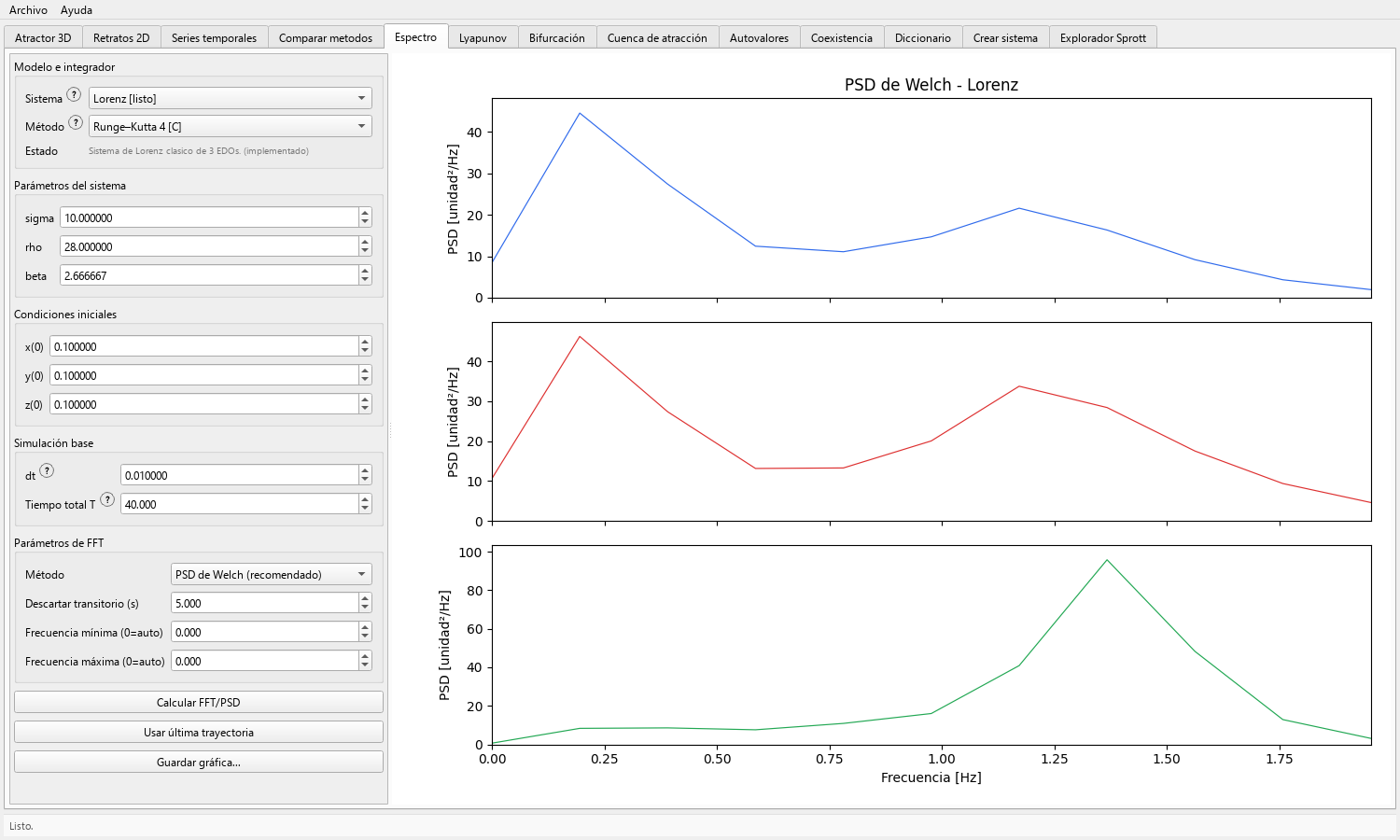
Cálculo de PSD y espectro de amplitud
- Genere una trayectoria en Atractor 3D, abra Espectro y seleccione Usar última trayectoria; también puede configurar el mismo sistema directamente en esta pestaña.
- Defina un transitorio suficientemente largo para conservar el movimiento asentado. La pestaña calcula y grafica juntas todas las componentes de estado mostradas como conjunto de observación.
- Seleccione Welch PSD (recomendado) para comparar potencia distribuida o Espectro de amplitud cuando interese la magnitud de las componentes discretas de frecuencia.
- Confirme que
dty la duración total admitan el intervalo y la resolución en frecuencia requeridos por el estudio. - Genere la gráfica, inspeccione los picos y las regiones de banda ancha, y repita con una ventana más larga o un paso menor para evaluar la sensibilidad numérica.
- Guarde la figura sólo después de registrar el sistema, los valores de los parámetros, el estado inicial, el método de integración,
dt, el tiempo total, el transitorio, las componentes mostradas y el modo espectral.
Unidades y modos espectrales
El análisis espectral transforma una señal muestreada en el dominio del tiempo en contenido de frecuencia. Las trayectorias periódicas suelen mostrar picos estrechos en una frecuencia fundamental y sus armónicos, mientras que las trayectorias irregulares pueden distribuir la potencia en bandas más amplias.
Toolbox Chaos ofrece dos resultados distintos. La densidad espectral de potencia de Welch promedia segmentos con ventanas superpuestas para reducir la varianza de la estimación; el espectro de amplitud informa la magnitud de las componentes de Fourier. Conserve la magnitud física y la etiqueta correspondientes para cada resultado. La pestaña dibuja una curva por cada coordenada mostrada porque cada una observa una proyección diferente de la órbita.
Un espectro es una herramienta de comparación y caracterización. La energía de banda ancha puede respaldar una interpretación de movimiento irregular cuando se articula con trayectorias, transitorios, sensibilidad al paso, estructura de bifurcación y diagnósticos de Lyapunov con convergencia.
Parámetros que definen el espectro
- Paso de muestreo:
dtcontrola la frecuencia más alta representada antes de que el aliasing afecte la señal muestreada. - Tiempo total: las ventanas más largas mejoran la resolución en frecuencia; las ventanas cortas difuminan los picos.
- Eliminación del transitorio: el comportamiento inicial puede dispersar energía entre frecuencias y ocultar el régimen final.
- Componentes mostradas: compare las curvas x, y y z porque pueden destacar frecuencias distintas de la misma trayectoria.
- Modo espectral: una Welch PSD mide potencia por unidad de frecuencia, mientras que un espectro de amplitud mide la magnitud de las componentes de Fourier.
- Intervalo de frecuencia: alejar demasiado la vista puede comprimir la estructura útil de bajas frecuencias.