Toolbox Chaos procedure
Custom Flow and Map Definitions
Define a continuous flow or discrete map through the graphical editor, validate its restricted expressions, simulate it, and exchange the definition as JSON.
Question and result
Calculation performed
Turn a clearly stated set of equations into a safe, portable exploratory GUI experiment while keeping it distinct from the curated catalog.
Required configuration
- Write one state variable and one right-hand-side or update expression for each dimension.
- Choose numeric parameter values, an initial state of matching length, and a divergence threshold appropriate to the scale.
- Use only the arithmetic operators and mathematical functions accepted by the restricted expression parser.
Panel and figure
Displayed quantities
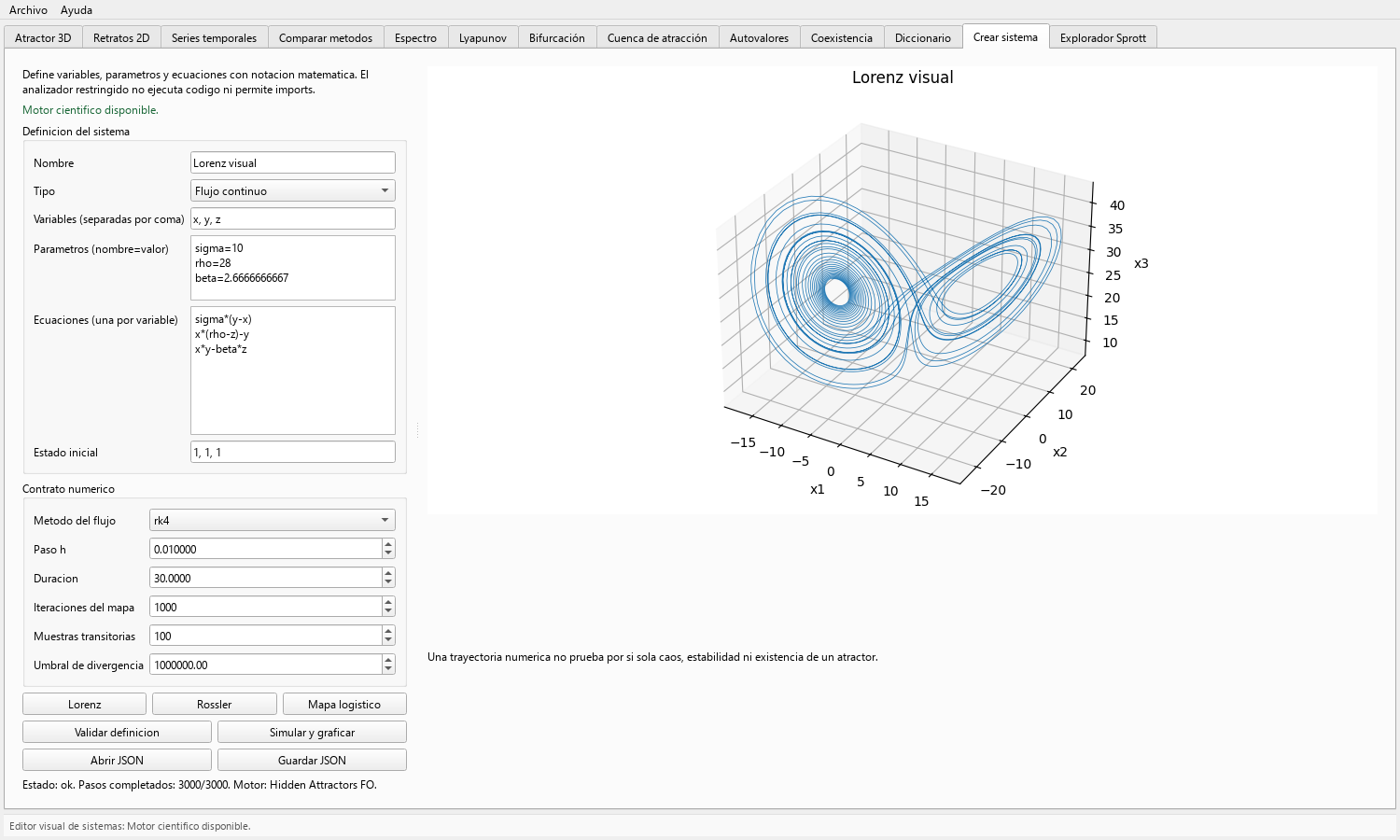
Configuration and calculation
Control sequence
-
Start from an example
Press Lorenz, Rossler, or Mapa logistico to load a complete definition. Inspect how variables, name=value parameters, one-equation-per-line input, and initial state correspond.
Simulate the unchanged example once to confirm the editor and mathematical engine are available in the installed build.
-
Define the model identity
Enter a descriptive name and select Flujo continuo or Mapa discreto. List variables separated by commas in the same order used by the equations and initial state.
A user-defined model remains a user definition. Inclusion in the curated system selector follows explicit catalog curation.
-
Enter parameters and equations
Write one numeric parameter assignment per line and one expression per state variable. Avoid ambiguous implicit multiplication and verify signs and parentheses against the source equations.
The restricted parser accepts the documented expression language. Correct a rejected expression within that language before validation.
-
Set the numerical contract
For a flow, select RK4 or Heun, step, and duration. For a map, set iteration count. Choose transient samples and a divergence norm threshold for plotting and safe termination.
The transient setting affects the displayed result; preserve it in the experiment record.
-
Validate before simulating
Press Validar definicion and resolve any variable, parameter, equation-count, syntax, or initial-state mismatch.
Then press Simular y graficar. The output adapts to one-dimensional, two-dimensional, or three-or-more-state definitions using an appropriate view.
-
Exchange the definition
Use Guardar JSON to preserve the canonical validated definition and Abrir JSON to restore it later.
Keep the JSON with the figure and numerical settings. Revalidate after loading, especially when sharing across application versions.
Toolbox Chaos and the mathematical engine
Toolbox Chaos owns the graphical form, interaction, plotting, JSON exchange, and exploratory workflow. A separately packaged Hidden Attractors FO engine can validate and simulate compatible definitions behind the interface. Hidden-attractor localization research remains in the dedicated engine workflows.
Record
Computed data
- A validated user definition with matching variables, equations, parameters, and initial state.
- A finite trajectory result or an explicit divergence/error status under the chosen numerical contract.
- A JSON model file that can be reopened and audited independently of a screenshot.
Scientific reading
Interpretation criteria
Successful validation establishes structural and syntax compatibility. Physical correctness and mathematical validity are assessed against the model source and independent analysis.
A plotted trajectory realizes the entered equations numerically; claims about chaos, stability, attraction, novelty, or agreement use the corresponding validation evidence.
Files
Experiment record
- Save the JSON definition and a plain-language source or citation for the equations.
- Record flow or map, method, step or iterations, duration, transient, divergence threshold, and application version.
- Keep any external comparison or validation results separate from the GUI-generated trajectory.
Applications
Questions addressed by the calculation
- Rapid prototyping of low-dimensional nonlinear flows and maps.
- Classroom exercises that vary equations or parameters through the graphical editor.
- Sharing a compact model definition among collaborators before implementing a specialized research pipeline.
Scope
Evidence conditions
- Custom definitions use the editor, simulation, validation, and JSON exchange capabilities selected for the workflow; catalog-specific equilibria, Jacobians, basin classifiers, bifurcation presets, and native optimization remain attached to their supported contracts.
- Only the methods and mathematical functions exposed by the editor are part of this GUI workflow.
- The Hidden Attractors FO package provides localization routines through its own mathematical-engine workflow.